Hotel no-show charges: when they can charge you and how to complain
10 October 2026

Yes, a hotel can charge you for not turning up to a booking, but only when the cancellation policy was clearly stated before you paid and forms part of the contract you accepted. There are force majeure exceptions that let you ask for a refund, and the most common charges are the first night, the full rate or keeping the deposit.
In short:
- The charge may be the first night, the deposit or the whole stay; non-refundable rates usually require the full amount.
- The general 14-day withdrawal period does not cover accommodation booked for specific dates; a flexible rate avoids charges if you cancel within the stated deadline.
- In the event of a disaster, a serious illness or a flight cancelled for reasons beyond your control, document what happened and let the hotel know as soon as possible; a refund is not automatic.
- Keep the confirmation, screenshots of the terms and your messages; complain if the policy was not shown before you paid or the charge is disproportionate.
- First make a formal complaint to the hotel; it must reply within the time limit set by consumer law and, if it does not resolve the matter, you can go to the consumer authorities.
Table of contents
- What a no-show is and why it affects the hotel
- Legal and contractual requirements for the hotel to charge
- Types of no-show charges and practical examples
- What to do if you are charged a no-show fee: steps to complain
- How to avoid being charged for a no-show: practical tips
- The legal side of no-shows at hair salons, spas and other appointment-based services
- How businesses should design a clear no-show policy
- What really matters when we talk about no-show charges
- How we help appointment-based businesses reduce no-shows
- Frequently asked questions
- Sources
What a no-show is and why it affects the hotel
A no-show happens when you book a room and neither turn up nor let the hotel know, unlike a cancellation, where you tell them in advance that you will not be travelling. The difference matters because it decides which policy applies: cancelling within the deadline is usually free, whereas a no-show almost always triggers the maximum charge set out in the booking terms.
For the hotel, a room that is held and left empty is a real cost. It has already turned down other requests for those dates, kept cleaning and reception staff ready, and cannot resell that night at the last minute. The no-show fee works as compensation for that lost income, not as an arbitrary penalty.
The consequences show up on several fronts:
- Direct loss of that night's income, which can no longer be recovered by selling it to another guest.
- Fixed staff and maintenance costs that remain even if the room stays empty.
- Gaps in occupancy forecasts, especially in high-demand seasons.
- Having to absorb the gap in the average revenue per available room.
That is why most establishments, especially those with non-refundable or high-season rates, include a specific no-show clause in their terms. The challenge for you as a guest is knowing whether that clause is valid and when you can challenge it.
Legal and contractual requirements for the hotel to charge
What decides whether a no-show charge is legitimate is the information given beforehand. The hotel must explain its cancellation and no-show policy before you complete the booking, clearly and accessibly, not hidden behind an obscure link or in tiny print. According to Hosteltur, hotels may apply no-show charges when the policy has been communicated clearly and before the booking, and those charges act as compensation for breach of contract, not as a fine.
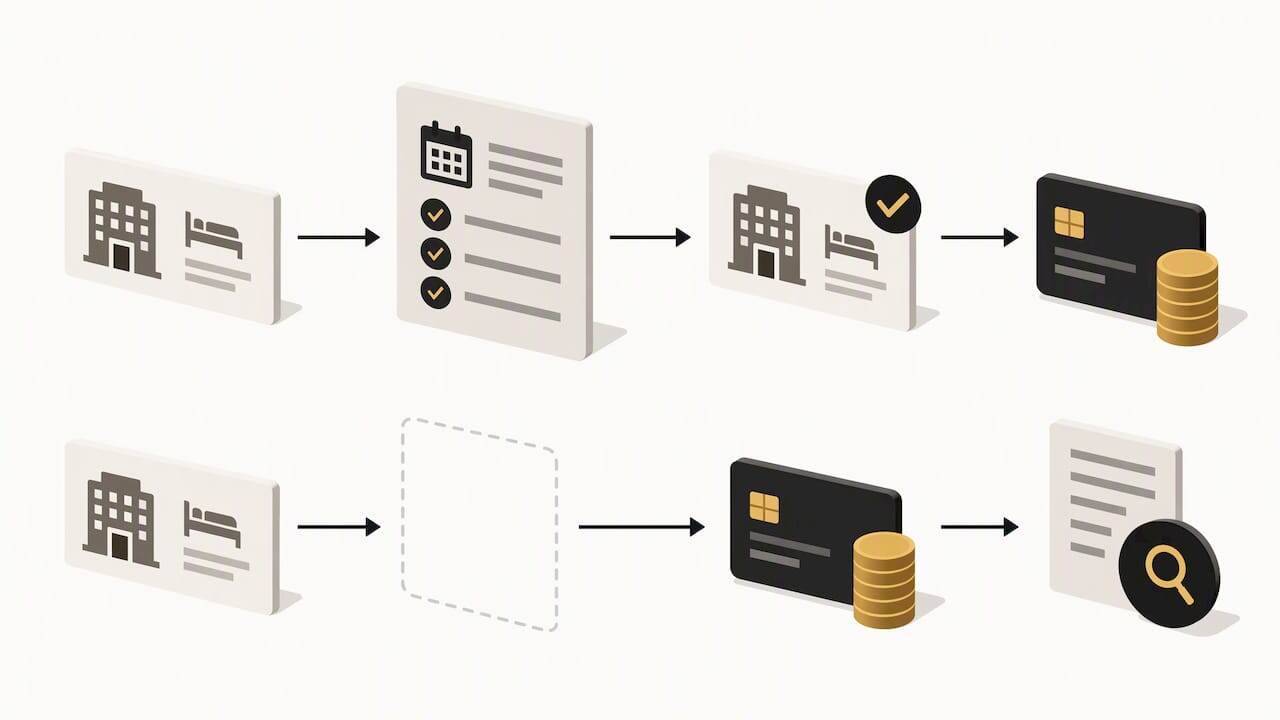
The same source points out something key for you: when that prior information is missing, the charge may become unfair and can therefore be challenged. Transparency is not a bureaucratic detail; it is the condition that makes the charge legitimate.
It is worth clearing up a common source of confusion here: the 14-day right of withdrawal that applies to many online purchases does not apply to accommodation services for specific dates. The official leaflet on the right of withdrawal from the European Consumer Centre explains that bookings for specific dates create a binding contract governed by the provider's policy, not by that general withdrawal period. In practice, this means you cannot cancel free of charge just because fewer than 14 days have passed since you booked.
Unfair terms do, however, have a limit. Consumer organisations keep a close eye on this area:
- A charge that is disproportionate to the actual price of the room can be challenged as unfair.
- A clause that was not communicated before the booking carries less weight as a justification for the charge.
- An ambiguous or confusingly worded policy works in your favour if you complain.
FACUA points out that, in exceptional situations such as natural disasters, it is worth complaining and seeking an agreement with the establishment, and that no-show clauses without adequate information, or disproportionate ones, can be reported and penalised.
The business has a maximum time limit to respond to a complaint, set by consumer law, and there are alternative dispute resolution (ADR) schemes and the ECC-Net network for cross-border cases, as the European Consumer Centre explains. That time limit gives you a realistic framework: if the hotel does not reply within it, you can escalate the complaint.
Force majeure changes the picture. If you cannot turn up because of extraordinary circumstances (a disaster, a documented serious illness, a flight cancelled for reasons beyond your control), you have room to ask for the booking to be cancelled without further charges, although there is no automatic right to extra compensation. What matters most is documenting the cause and telling the hotel as soon as possible, not after the charge has been applied.
Types of no-show charges and practical examples
Hotels do not use a single formula to charge for a no-show. The amount depends on the type of rate you chose and how much leeway the cancellation policy allowed.
- First-night charge. This is the most common format: the hotel charges for a single night, even if the booking was for several, and releases the rest.
- Keeping the deposit. If you paid a deposit when booking, the hotel keeps that amount and charges nothing more.
- Full rate for the stay. This mainly applies to non-refundable or high-season bookings, where the price already included that condition from the start.
- Tiered policies depending on notice. Cancelling 30 days ahead may be free, 7 days ahead may cost 50 %, and a straight no-show triggers the maximum charge.
Let's look at three common scenarios. If you booked a non-refundable rate to save 15 % on the flexible price, a no-show will cost you the whole booking, with no exceptions other than proven force majeure. If you paid a 20 % deposit when confirming the booking, you will most likely lose only that deposit and not the rest of the amount. And if you chose a flexible rate with free cancellation up to 24 or 48 hours beforehand, a no-show outside that window may cost you the equivalent of one night, whereas letting them know within the deadline costs you nothing.
Pro tip: before confirming a booking, weigh what you save with the non-refundable rate against the real risk of your plans changing: sometimes the extra €10 or €15 for the flexible rate is worth more than the risk.
What to do if you are charged a no-show fee: steps to complain
If you see a charge that seems unfair, the first step is to check the terms you accepted when booking, not the ones you remember. Check whether the no-show policy was clearly shown before you paid and whether the amount charged matches what was advertised.
Gather your paperwork before writing any complaint:
- Booking confirmation showing the cancellation terms.
- Emails or WhatsApp messages exchanged with the establishment.
- Screenshots of the policy as it appeared when you booked.
- Evidence of force majeure, if applicable (medical report, proof of flight cancellation, official disaster warning).
With that paperwork, first send a formal complaint to the hotel itself, setting out the facts and asking for the charge to be reviewed. If you do not get a satisfactory answer, you can go to your local Municipal Consumer Information Office (OMIC) or, for cross-border bookings within the European Union, to the European Consumer Centre, which recommends documenting your communication well and seeking an amicable agreement first before escalating to formal channels. Alternative dispute resolution (ADR) schemes are the next step if a direct agreement does not work.
As for timescales, keep your expectations realistic: the establishment has a set period to reply to your initial complaint, and a refund, where due, can take several more weeks to come through. Do not expect an immediate answer, but do keep a record of every step you take.
How to avoid being charged for a no-show: practical tips
The best defence against a no-show charge is prevention, not a complaint afterwards. A few simple habits reduce the risk to almost zero.
- Read the full cancellation policy before paying and save a screenshot with the date visible.
- If you are unsure of your plans, choose a refundable rate even if it costs a little more than the non-refundable one.
- Ask for written confirmation of the booking and keep the receipts for any payment or deposit.
- Use any reminders the hotel offers by WhatsApp or email to confirm your arrival in advance.
- If you are asked for a deposit instead of full payment, consider whether the risk of your plans changing justifies that option over the full rate.
Pro tip: if you book well in advance and are not sure of your dates, put the free cancellation deadline in your calendar, not just the date of your stay: that is the date that really matters.
The legal side of no-shows at hair salons, spas and other appointment-based services
No-show charges are not exclusive to hotels. Hair salons, spas, dental clinics and physiotherapy centres are increasingly applying them, and the legal basis is similar: the business can charge a penalty or keep a deposit if it disclosed that condition before confirming the appointment.
The main difference from accommodation is that these services do not usually involve a formal booking contract like a hotel's. Even so, if the business communicated its cancellation policy at the time of booking, by WhatsApp, by phone or on the premises, that communication counts as acceptance of the terms. Charging 100 % of the service for not turning up without notice, when the business made it clear that cancelling with less than 24 hours' notice has a cost, falls within what is reasonable.
What does not fit is a charge that comes out of nowhere, without having been communicated before the appointment, or one that is disproportionate to the actual price of the service. Just as in the hotel sector, prior transparency is what makes a no-show policy legitimate rather than unfair, and the same complaint channels (OMIC, consumer associations) apply to these businesses.
How businesses should design a clear no-show policy
A business that wants to protect its income without creating conflict with its customers needs a no-show policy that is simple, visible and consistent across all its channels. This reduces complaints and stops a legitimate charge from being seen as abuse.
Some practices that make a difference:
- Explain the cancellation policy at the time of booking, not afterwards, and repeat it in the confirmation.
- Use plain language that states how many hours in advance customers can cancel free of charge.
- Send automatic reminders before the appointment to reduce forgetting, which is the most common cause of no-shows.
- Apply the same criteria to every customer, without arbitrary exceptions that are hard to justify later.
- Keep a record that the customer received and accepted the policy, for example through a confirmation message.
A business that automates these notices not only reduces no-shows but also reduces the number of complaints, because the customer cannot claim not to know about a condition they received in writing before their appointment.
What really matters when we talk about no-show charges
Public debate about no-shows tends to focus on whether the charge is “fair” or not, but that is the wrong question. The right question is whether the policy was communicated before you decided to book. A high charge with clear prior information is easier to defend than a low charge that came as a surprise at the moment of payment.
What is most underrated is the value of keeping evidence from the very first minute. Most people only look for their booking confirmation once they already have a problem, and by then they sometimes cannot find it. Saving a screenshot of the policy when you book takes ten seconds and completely changes your bargaining position if something goes wrong.
And there is an imbalance worth acknowledging: small businesses that depend on their appointment book (hair salons, beauty centres, spas) usually have less room to absorb a no-show than a hotel chain. That is why prioritising prevention, reminders and reasonable deposits benefits both sides more than any charge applied after the fact.
How we help appointment-based businesses reduce no-shows
If you run a business where no-shows hit your turnover directly, automating communication with your customers is the change with the most real impact. We answer your customers on WhatsApp with artificial intelligence, leave the appointment booked in your diary and handle bookings, changes and cancellations even outside your working hours.
Among the practical benefits:
- Your customers can cancel or change their appointment on WhatsApp and, on the Pro and Premium plans, we offer the cancelled slot to the waiting list.
- On the Premium plan, we ask for a deposit through Stripe at the time of booking, for the services you choose.
- We bring all communication with your customers into a single channel, without losing messages outside working hours.
You can write to us from Vural and we set it all up with your business's details; setup has a fixed price depending on the plan, and the monthly fee starts once it is working.
Frequently asked questions
What does no-show mean for flights?
In air travel, a no-show is when a passenger does not turn up for boarding without having cancelled the flight beforehand. The airline usually treats the ticket as forfeited and, if the booking included several legs, may automatically cancel the remaining flights on the itinerary.
What is check-out in the hotel trade?
Check-out is when the guest leaves the room and officially ends their stay, usually before a deadline set by the hotel. It has no direct connection with a no-show, which happens before arrival, not at the end of the stay.
How much do hotels charge to cancel a booking?
It depends entirely on each hotel's policy and the type of rate chosen: it can range from no charge at all if you cancel within the deadline to losing the deposit, the first night or the full rate on non-refundable bookings. It is always worth checking the specific terms of your booking before cancelling.
Is it possible to cancel a trip that has already been paid for?
Yes, but the terms depend on the contract you accepted when booking, since the general 14-day right of withdrawal does not apply to services for specific dates such as accommodation, according to the European Consumer Centre's official leaflet. If there is a documented force majeure cause, you have more room to ask for the booking to be cancelled without further charges.
How can I avoid a no-show charge when booking?
The simplest way is to read the cancellation policy before paying, save a screenshot of it and choose a refundable rate if you are not sure of your dates. Confirming your arrival through the channels the hotel offers also reduces the risk of any charge being applied.
Sources
More articles

11 October 2026
Appointment confirmation messages: templates ready to use today
Use appointment confirmation messages with ready-made templates for WhatsApp and email. Get more replies, cut no-shows and adapt every text to your business.

9 October 2026
Advance payment for appointments: how to introduce it without friction
Take payment for appointments in advance over WhatsApp: cut no-shows, forecast income better and stop your team chasing payments by hand.