Beauty salon reports: which to use and how to read them
28 October 2026

A beauty salon needs few reports, but good ones: diary occupancy, revenue and margin per treatment, cancellations and no-shows, returning clients and each person's history. With those you can see what works, where you lose appointments and what decision to take this month. In this guide we explain what to include in each report, how to calculate it, how often to review it and how to read it without getting lost in numbers.
In short
- Start with five reports: occupancy, revenue and margin per treatment, cancellations and no-shows, rebooking and inactive clients.
- Measure the real margin of each treatment, not just what you bill.
- Review the diary every week and the other indicators every month, comparing with the last 3 to 6 months.
- As well as management reports, you need client, treatment and referral records that are properly filed.
- If your data lives in WhatsApp, on paper and in a spreadsheet, the first step is to bring it together in one place.
Table of contents
- What “report” means in a beauty salon
- The five management reports you do need
- Which metrics to include and how often to review them
- How to read a report to spot problems and opportunities
- Client reports: records, follow-up and referral
- A single screen: the minimum dashboard
- Excel, management software or an AI assistant
- Vural's view: data starts in the conversation
- How Vural solves it
- Common mistakes when working with reports
- A four-week start-up plan
- Frequently asked questions
- Sources
What “report” means in a beauty salon
The word is misleading, because in beauty it is used for three different things. It is worth separating them from the start:
- Management reports: the business's numbers. How full you are, how much you earn, how many appointments fall through.
- Client reports: the beauty history, the treatment and follow-up records, the professional advice.
- Referral reports: the document you hand over when you spot a condition that is not yours to treat and you send the person to a healthcare professional.
This article focuses on the first kind, but also covers the other two, because they feed each other. If you don't record each visit properly, you can't calculate anything reliable later.
The five management reports you do need
You don't need a dashboard with forty charts. With these five reports you have almost everything under control.
1. Diary occupancy
It is the percentage of treatment-room or staff hours you have sold out of the hours available. It is calculated like this:
Occupancy = hours booked ÷ hours available × 100
Example: a therapist works 35 hours a week and has 26 hours with clients. Her occupancy is 74.3%. The remaining 9 hours are gaps. What is useful is to see where they are: if they always fall on Tuesday afternoons, you have a specific opportunity.
If you work with several treatment rooms or machines, look at occupancy per resource too. In our guide on how to manage the treatment rooms in your beauty salon you have a step-by-step method.
2. Revenue and margin per treatment
Billing a lot doesn't mean earning a lot. A treatment with expensive product, cleaning time and equipment depreciation can leave less than a quick, simple one.
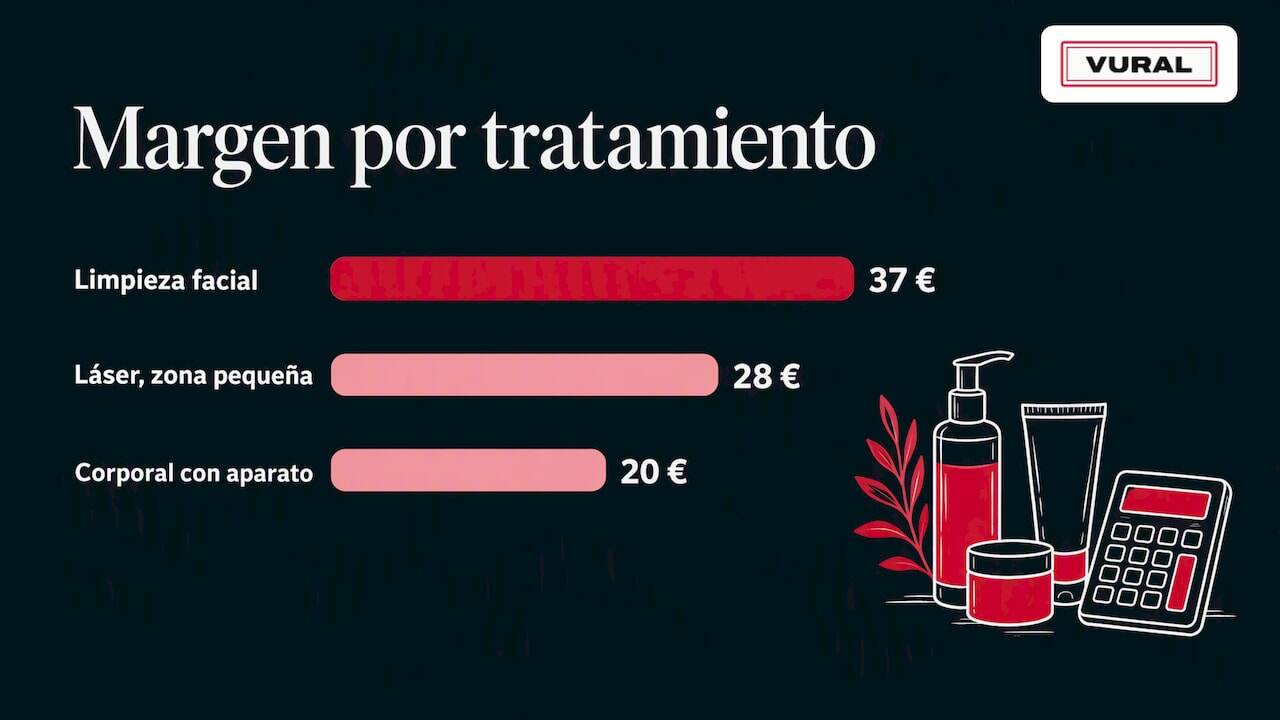
The consultancy TRAZO Consulting, in its guide to running a clinic with Excel or Power BI, recommends a profitability traffic light per treatment based on real margin and not just on billing. It also advises a break-even point that is updated when costs change.
A simple version for your salon:
Treatment Price Direct cost (product + time) Margin Traffic light Facial cleanse 55 € 18 € 37 € Green Laser hair removal, small area 40 € 12 € 28 € Green Body treatment with a machine 90 € 70 € 20 € RedThe amounts are an example so you can see the format: put in your own. The treatment in red isn't dropped automatically. Perhaps it's time to raise the price, shorten the session or sell it as a package.
3. Cancellations and no-shows
This report tells you how many appointments you lose and why. Include at least:
- Appointments cancelled more than 24 hours in advance.
- Appointments cancelled on the same day.
- Clients who don't turn up without warning.
- How many of those gaps you managed to fill again.
The last point is the one most often forgotten. A cancellation with notice is a small problem if you have a waiting list or a quick way to offer the slot. A no-show without warning is a lost slot. If you want to reduce them, see how to introduce advance payment for appointments without friction and how WhatsApp appointment reminders work.
4. Rebooking: clients who leave with their next appointment
Rebooking measures how many people leave your salon with their next appointment already booked. The formula is simple:
Rebooking = clients seen with a next appointment ÷ clients seen × 100
If you saw 90 people and 48 left with an appointment, your rebooking rate is 53.3%. It is a very honest indicator: it shows whether your clients see value in coming back and whether your team suggests the next visit before they leave.
For treatments with a clear schedule, such as laser sessions or facial courses, it should be high. If it is low, the problem usually lies in the offer, not the client.
5. Inactive clients
This is the list of people who have gone past their usual return cycle. If a client usually comes every five weeks and hasn't been seen for twelve, something has happened. She may have gone elsewhere or simply forgotten to book.
This report leads straight to an action: get in touch with them. You'll find ready-made templates in our guide to reactivating inactive clients.
Which metrics to include and how often to review them
Not everything is checked with the same frequency. If you review revenue every day, you'll get stressed. If you look at the diary once a quarter, you'll be too late.
Frequency What to review What for Every week Occupancy for the next 7 to 14 days, free slots, cancellations Move appointments, fill gaps, alert the waiting list Every month Revenue, margin per treatment, average spend, no-shows, rebooking Adjust prices, staffing and promotions Every quarter Trends, inactive clients, profitability per service Decide what to expand, what to change and what to dropThe average spend is revenue divided by the number of clients seen. If it rises because you sell more add-on treatments, good. If it rises only because you've put prices up and the number of clients falls, it's worth looking at more carefully.
If you want to go deeper into the formulas, see the guide on booking KPIs: what to measure and how to calculate them.
How to read a report to spot problems and opportunities
A number on its own says nothing. 68% occupancy can be excellent or terrible depending on where you're coming from. What matters is the comparison.
Compare with your own history
TRAZO Consulting advises comparing each indicator month on month and with the last 3 to 6 months. That way you can tell a one-off dip from a trend. If occupancy drops in August every year, it's seasonality. If it falls three months in a row outside the season, it's a warning sign.
Cross two figures at once
Useful conclusions come from crossing reports. Some examples:
- High occupancy and low margin: you work hard to earn little. Review prices or duration.
- Low occupancy and low rebooking: the problem isn't attracting clients, it's keeping them.
- Lots of no-shows for a particular treatment: it may need a deposit or a specific reminder.
- Lots of inactive clients after a service: perhaps follow-up is missing.
Set one question and one action per report
When you finish reading each report, write one sentence: “what I've seen”, and another: “what I'm going to do this week”. If there's no action, the report hasn't been any use.
An example case
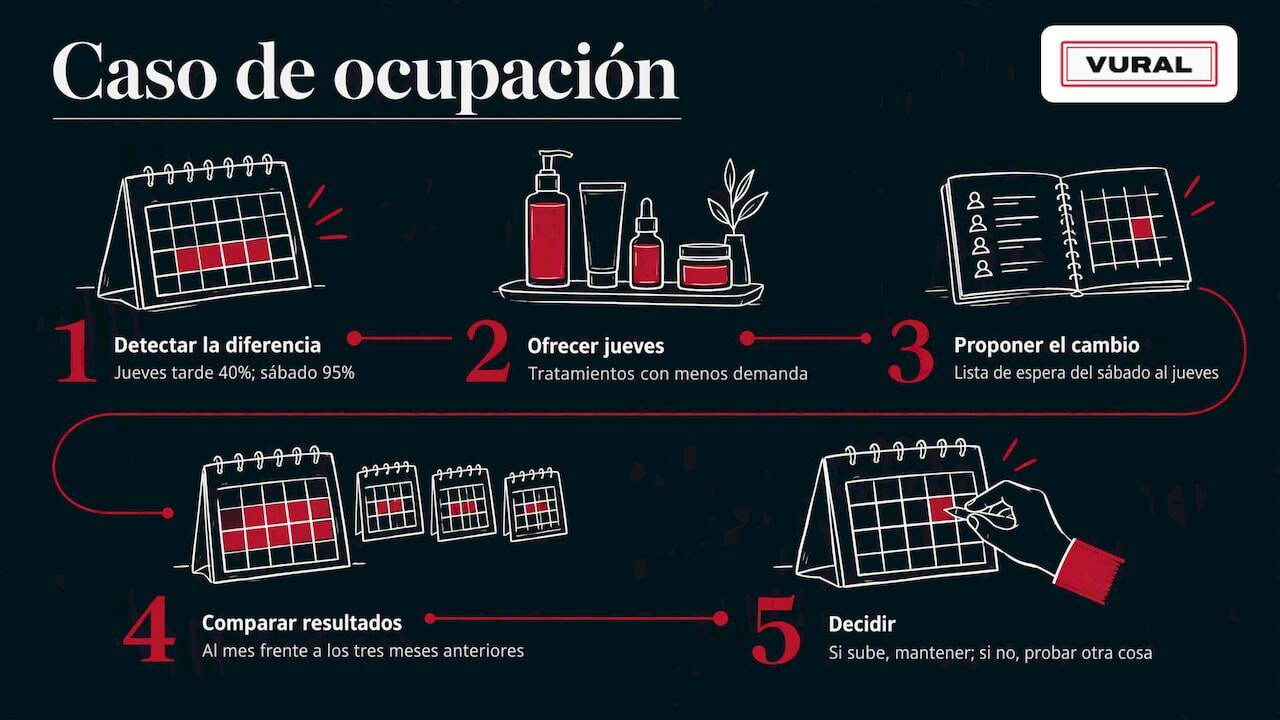
Imagine a salon with three therapists. In the weekly report you see that occupancy on Thursday afternoons is 40%, while on Saturdays it's 95%. The action: launch a Thursday offer for the treatments in least demand, and offer the clients on the Saturday waiting list a move to Thursday. A month later, you compare with the previous three months. If it has gone up, you keep it. If not, you try something else.
Client reports: records, follow-up and referral
The management numbers come from what you record at each visit. That's why the client documents matter too.
The training material from the Inespa institute on hair and scalp aesthetic diagnosis, set out in its diagnosis protocol, lists the usual documentation: beauty history, condition assessment records, treatment and follow-up records, professional advice and referral reports where appropriate. It points out that these documents are confidential and precise, and are filed so that they can be accessed easily.
Translated into your day-to-day:
- Beauty history: allergies, products they use, previous treatments, expectations.
- Treatment record: what was done, with which product or machine, settings and date.
- Follow-up: how it progressed and when the next session is due.
- Professional advice: what you recommended for home care.
- Referral report: if you see a condition that is for a healthcare professional, you note it down and refer.
A simple referral report includes the client's name, the date, who they are referred to and what you observed in the cosmetic examination. Describe what you see, never give a medical diagnosis: that is for whoever receives the referral.
As these records contain personal and sometimes health data, keep them in a system with controlled access and not in a notebook or scattered chats. If you're unsure how long to keep them or what consent to ask for, check with your accountant or a data protection adviser. There's a practical guide for hair salons, very applicable to beauty, on what to include in a client record and how to keep it.
A single screen: the minimum dashboard
TRAZO Consulting suggests bringing together on a single screen billing, margin, occupancy, average spend and cost per patient. Adapted to a beauty salon, a minimum dashboard would have:
- Revenue for the month and comparison with the previous month.
- Margin per treatment, with a traffic light.
- Occupancy for next week.
- Average spend.
- No-shows and cancellations for the month.
- Rebooking.
- Number of inactive clients.
Seven figures. If it takes you more than ten minutes to read them, there are too many or they're badly organised.
Excel, management software or an AI assistant
There are three usual routes:
- Excel or a spreadsheet: cheap and flexible. It works if you're disciplined and have few appointments. It gets complicated when bookings come in by WhatsApp, phone and Instagram and have to be copied over by hand.
- Management software or diary software: automates part of the calculation, but client communication often stays on another channel.
- AI diary connected to WhatsApp: the booking, the cancellation and the report all come from the same place, so the data arrives together.
The key isn't the tool, but that the data is recorded only once and without errors. A report is only as good as the data that goes into it. If you want to compare at your leisure, see our guide to the digital appointment book for appointment-based businesses.
Vural's view: data starts in the conversation
In appointment-based businesses, the problem is hardly ever a lack of reports. It's that the data is scattered. One booking arrives by WhatsApp at eleven at night, another by phone, another is jotted down on paper by someone. At the end of the month, nobody knows how many appointments were lost by not replying in time.
That's why we believe the most useful report is the one that generates itself, because the diary and the conversation with the client are in the same place. When the assistant replies on WhatsApp, books, changes or cancels the appointment and notes it in the client record, every step is logged. You don't have to type anything in again to know your occupancy, your cancellations or which clients haven't been back for months.
We also think a report should be there to act on, not to look nice. That's why what we recommend is to start with very few indicators, check them consistently and decide on one improvement each week.
How Vural solves it
Vural is an AI virtual assistant for appointment-based businesses, such as beauty salons, hairdressers, physiotherapy centres and dental clinics. It answers your WhatsApp in real time, outside opening hours too, books, changes and cancels appointments, keeps a record for each client (previous appointments, notes and preferences) and connects to Google Calendar. On the Pro plan it offers cancelled slots to the waiting list and prepares the business report; the weekly summary and taking a deposit with Stripe at booking are on both plans. It learns your salon's tone and vocabulary and respects the prices and terms you set. What's more, it charges no commission per appointment and has no minimum term.
The plans are monthly: Solo at 49 € a month and Pro at 69 € a month, excluding VAT. Setup is a one-off payment at a fixed price depending on the plan: 299 € on Solo and 499 € on Pro. If you need more AI conversations, you can add packs of 100 conversations for 19 €. We set it up with your business's details and the fee starts once it's working, with no minimum term and no commission per appointment. See Vural's plans and choose the one that fits what you want to automate in your salon.
If you'd like to keep learning first, there are more articles for appointment-based businesses on the blog, including one on the WhatsApp away message.
Common mistakes when working with reports
- Measuring too much: the more indicators, the less you look at them. Stick to the seven basics.
- Looking only at billing: it can grow while the margin falls.
- Not comparing: a number with no reference is no use. Compare with the previous month and with the last 3 to 6 months.
- Incomplete data: if you don't record cancellations or no-shows, your occupancy looks better than it is.
- Reports with no action: if no decision comes out of it, change the report.
- Neglecting privacy: records with personal and health data should not be passed around in personal chats.
A four-week start-up plan
- Week 1: decide on the five reports and define how each one is calculated. Write it down on a sheet.
- Week 2: gather the data for the last three months: appointments, cancellations, revenue and costs per treatment.
- Week 3: work out the margin traffic light and the first list of inactive clients. Message ten of them.
- Week 4: do your first full monthly review, note down one decision and set the date for the next one.
By the end you'll have a routine of about 30 minutes a week. You don't need more.
Frequently asked questions
What reports does a beauty salon need as a minimum?
Diary occupancy, revenue and margin per treatment, cancellations and no-shows, rebooking and inactive clients. With these you keep track of activity and spot where you're losing money. Add client and treatment records so that every visit is recorded.
How often should I review the reports?
The diary, every week, because it's the only thing you can still act on in time. Revenue, margin, average spend and rebooking, every month. Trends and profitability per service, every quarter, comparing with the last 3 to 6 months.
How do I calculate my salon's rebooking rate?
Divide the clients who leave with their next appointment already booked by the total number of clients seen and multiply by 100. If 48 out of 90 clients leave with an appointment, the result is 53.3%. Always measure it over the same period so you can compare.
Can I keep the reports in Excel?
Yes, if you have few appointments and record everything with discipline. The problem comes when bookings arrive through several channels and have to be copied over by hand, because errors pile up. At that point a diary that records appointments at source pays off.
What does a referral report in beauty include?
The client's name, the date, who they are referred to and what you observed in the cosmetic examination. Describe what you see without giving a diagnosis, because that is for the healthcare professional who receives the client. Keep a copy in the record.
Sources
- TRAZO Consulting: How to run your clinic with Excel or Power BI (in Spanish)
- Inespa: UT2 Hair and Scalp Aesthetic Diagnosis Protocol (in Spanish)
Recommended reading
More articles

1 November 2026
How to ask your customers for reviews on WhatsApp in 2026
Learn how to ask for Google reviews on WhatsApp: when to send the request, how to get the link, templates for each type of business and what Spanish law says.

31 October 2026
How to avoid overbooking in your appointment diary
Why appointments get double-booked in hair salons, beauty salons and physio practices and how to stop it: one calendar, confirmations and a waiting list.