Reactivating inactive customers: a guide with templates
15 October 2026
Pull out your list of inactive customers, sort it by recency and value (RFM) and send them an automated multichannel sequence. The steps are: identify, segment, write the message, automate and measure. One warning: the moment you get in touch should come from signals in each customer's data, not from a fixed rule such as “two months without coming in”.
In short:
- Prioritise those who combine high value with a likely response; save the personal touch for valuable customers who show few signs of coming back.
- Filter out future appointments, unsubscribes and changed phone numbers; if there was a complaint, get in touch with an apology or an open question, never with an offer.
- Move from email to WhatsApp and SMS only if there is no reply; phone only your most valuable customers and stop the sequence as soon as they reply or book.
- Compare reactivation against a control group, change only one variable per test and record where each booking came from to avoid misattribution.
Table of contents
- How to spot inactive customers with your diary data
- Who to win back first: segmentation and priority
- How to set up a multichannel reactivation campaign
- Message templates for WhatsApp, email and SMS
- When to get in touch: inactivity signals instead of fixed rules
- How to measure results and test improvements with A/B tests
- Reactivating without commission: a competitive edge
- Fair treatment is worth more than any discount
- Look after returning customers with a diary that answers on WhatsApp
- Frequently asked questions
- Sources
How to spot inactive customers with your diary data
Before you write a single message, decide what “inactive” means for your business. For appointment-based services it pays to use RFM: recency (when they last came in), frequency (how many times a year they come) and value (how much they spend on average). The fields you need are already in your diary or customer record.
- Recency: date of the last completed appointment, not counting cancellations or no-shows.
- Frequency: number of appointments in a recent period.
- Value: average spend per visit or total spend per customer.
- Expected cycle: the usual number of days between appointments for that particular customer.
Fixed rules fail because every customer has their own rhythm. Someone who comes in often becomes inactive much sooner than someone who visits the business now and then. A 2023 study found that sends based on fixed time rules tend to fail, and that control charts (gamma–gamma) work better: they model the time between each person's purchases and flag inactivity when it falls outside their pattern, with fewer false alarms.
To avoid false positives, leave out anyone who already has a future appointment booked, anyone who has unsubscribed and anyone who has changed phone number. If you keep bookings and data together in a digital appointment book, these filters are quick to apply and the list stays clean on a regular basis.
Who to win back first: segmentation and priority
Not every inactive customer deserves the same effort. We agree with a municipal guide on how to reactivate inactive customers on one point: define what an inactive customer is, analyse the causes and segment by value and behaviour before sending generic messages. The segments that work best are these:
- High value lost: customers who used to spend the most and have gone more than one cycle without coming in. They deserve a personal touch.
- Recent regulars: they came in regularly and have missed an appointment or two. They are the easiest to win back.
- Low cost, high response: low-spend customers who reply quickly to a message. An automated sequence is enough.
Combine value and likelihood in a simple matrix: high value and high likelihood go first; high value and low likelihood get a more careful approach; low value and high likelihood go into the automation; low value and low likelihood wait.
You don't need complex models to estimate the likelihood. Look at how long it has been since the last visit, which service they used to book (regular services respond better) and whether they have replied to campaigns or reminders before.
Be tactful with anyone who left after a complaint or who recently unsubscribed. For them, a promotional message can go down worse than silence: get in touch with an apology or an open question, never with an offer.
How to set up a multichannel reactivation campaign
Each channel has its role. Email is cheap and allows more text, but it is rarely read. WhatsApp gets plenty of opens and allows an immediate reply. SMS is short and reaches everyone. A phone call is the most expensive channel, so save it for your most valuable customers. Push notifications only work if the customer has your app.
A sequence that scales well:
- Reminder email: a friendly tone, a reference to the last service and a link to book.
- Personalised WhatsApp: a few days later if there was no open or reply, with their name and a specific slot on offer.
- Short SMS: one line with the booking link, for those who open neither email nor WhatsApp.
- Phone call: only for high-value customers who still haven't replied.
The rule for moving on is simple: if there is no reply or booking within the set time, the flow moves to the next channel on its own, and stops as soon as the customer books or replies. That is what any well-configured automated flow should do.
Watch the cadence: a limited number of contacts over a short period, several days apart, and always at reasonable times (mid-morning or early afternoon, never at night). The minimum personalisation is name, last service and a specific date or slot.
If you use WhatsApp, how quickly you reply matters as much as the first message; see our guide on WhatsApp response time.
Pro tip: don't send the sequence to your whole customer base at once; test it on a small segment, fix the message and then scale up.
Message templates for WhatsApp, email and SMS
A good reactivation message includes: a greeting with their name, a reference to the last service, a value proposition or incentive, a clear call to action and an easy way to unsubscribe.
- WhatsApp (friendly and short): “Hi Marta. We haven't seen you for a while since your last colour. This week we have slots on Thursday and Friday afternoon. Shall I book you one? If you'd rather not receive more messages, reply STOP.”
- Email (a bit longer, with a clear subject line): Subject: “Marta, we're keeping a slot for you”. Body: a reminder of the last service, something new or an incentive, a booking button and an unsubscribe link.
- SMS (one line): “Hi Marta, we miss you. Book your appointment here: [link]. To stop receiving these, reply STOP.”
- Feedback version: “Hi Pablo, is there anything we could have done better since your last visit? Your opinion helps us and, if you'd like to come back, we'll find you a slot.”
- Gentle urgency version: “There are a few slots coming up for your usual treatment. If you're interested, we'll keep one for you.”
Personalise without overdoing it: name, last service and date are plenty. A message that looks handwritten but reaches lots of people at once breeds mistrust. Always respect opt-outs and never write again to anyone who has unsubscribed; it's a matter of compliance and of trust. More ideas in our appointment confirmation templates.
When to get in touch: inactivity signals instead of fixed rules
The evidence points in a clear direction. The 2023 study we cited earlier concludes that identifying the precise moment within the individual purchase cycle improves reactivation compared with a fixed time rule. Without going into statistics: contact should be triggered when the customer drifts from their own rhythm.
Statistical control methods, which detect the precise moment in the individual purchase cycle, improve the effectiveness of reactivation compared with fixed time rules.
In an appointment-based business, a simple trigger is this: last appointment plus one expected cycle with no new booking. If a client usually comes every four weeks and six have gone by without an appointment, the signal fires. You don't need an advanced model; a calculated column in your diary or CRM is enough.
You have three options for automating it. You can create triggers in your CRM that set an inactivity flag. You can build a multichannel flow that sends the first message when the signal fires. And you can set up an automatic switch of channel when there is no reply, as we saw in the sequence above.
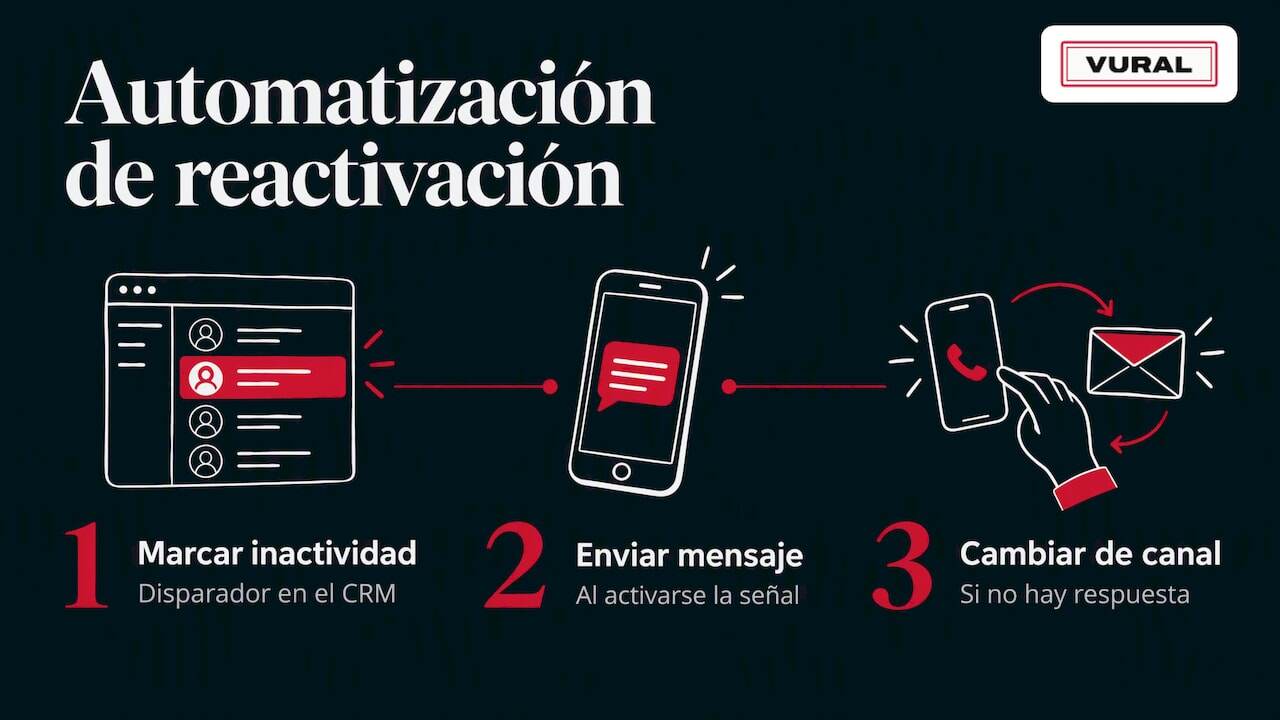
Other useful triggers: a customer who cancels appointments in a row without rebooking, or one whose seasonal service (for example, a treatment before the summer) is due again. If you also send reminders, use our guide to WhatsApp appointment reminders so that reactivation and reminders don't trip over each other.
Pro tip: regularly check how many customers trigger the signal and how many reply; if hardly anyone replies, the threshold is set wrong.
How to measure results and test improvements with A/B tests
Without measurement, a reactivation campaign is a gamble. These are the indicators that matter:
- Reactivation rate: percentage of contacted customers who book again.
- Incremental revenue: what reactivated customers spend, minus what they would have spent without the campaign.
- Cost per reactivation: time and tools invested divided by customers won back.
- Subsequent retention: how many keep coming in the following months.
To test an improvement, split a segment into two similar groups: one gets the campaign and the other (the control) gets nothing, or gets the previous version. Compare the reactivation rate between the two. Don't change more than one thing at a time (subject line, channel, incentive or time), and wait until you have enough replies per group before deciding.
The cycle is measure, adjust the message or the segmentation, and repeat. The most common attribution mistake is counting as reactivated someone who would have come back anyway; the control group prevents this. Record in your CRM where each booking came from (campaign, direct reply, phone call) to attribute it correctly.
Reactivating without commission: a competitive edge
When a booking platform charges you commission on every appointment, winning back a customer who was already yours costs you more than keeping them. Reactivating through your own channels (WhatsApp, email, SMS) cuts out that middleman: the booking is yours, the data is yours and so is the margin.
This gives you several advantages. You can offer more generous incentives, because you don't have to take commission off the price. You control the relationship with the customer and their history, something a marketplace won't hand over. And you measure the real cost of each reactivation with no hidden costs.
According to an industry study on customer management, reactivation matters more in B2C businesses where repeat custom is critical, and winning customers back is usually more profitable than attracting new ones. In appointment-based services, that logic holds completely.
The practical strategy is to move your customers to a channel of your own as soon as possible: note their WhatsApp number on the first visit, ask permission to message them and keep your own diary with their history. That way, when they go quiet, you already have a way to talk to them without paying anyone to do it.
Fair treatment is worth more than any discount
A common mistake is to think that reactivation is a question of price. The literature on winning back customers shows that success also depends on perceived fairness in the interaction, the process and the offer. An empathetic, transparent message carries as much weight as the incentive. What's advisable: simple processes, clear terms and short training for whoever answers reactivation messages or calls.
Look after returning customers with a diary that answers on WhatsApp
Vural doesn't send reactivation campaigns: you send the sequence. What it does is look after the customer who writes back. With Vural we answer your customers on WhatsApp at any time, even outside your opening hours, and we handle bookings with each customer's history in their record.
- We handle bookings.
- On the Pro and Premium plans, we offer cancelled slots to the waiting list, with no commission per booking.
Write to us from Vural and we'll set it up with your business's details: the set-up has a fixed price depending on the plan and the monthly fee starts once it's working.
Frequently asked questions
What line works to hook an inactive customer?
A line that mentions something specific from their last visit and offers an easy action works best: “Hi Marta, since your last treatment we've kept a slot for you this week, shall I book it?”. Avoid generic phrases and always include an easy way to unsubscribe.
How do you revive sales at an appointment-based business?
Start by spotting who has dropped out of their usual visit cycle and contact them with a multichannel sequence: email, WhatsApp, SMS and, for your most valuable customers, a phone call. Then measure how many book and adjust the message and channel according to the results.
What words can I use to win back a customer?
Use their name, the last service they booked and direct verbs such as “book” or “keep”. Lines that convey that their slot is available and that coming back is easy work well, with no pressure or guilt.
What should I do to win back lost customers?
First define what an inactive customer is for your business and find out why they left. Then segment by value and likelihood of replying, send personalised messages at the moment set by their own cycle and take particular care with those who left after a complaint.
Sources
Recommendations
More articles
16 October 2026
Automate physiotherapy appointments with AI and WhatsApp
Automate physiotherapy appointments with AI and WhatsApp: cut no-shows, free up reception hours and measure the return with a pilot before scaling it up.

15 October 2026
Booking KPIs: which to measure and how to calculate them
Learn how to measure booking KPIs: calculate occupancy, ADR, RevPAR, no-shows and conversion by channel so you can adjust your prices and reduce losses.